Lead Management
Capture, qualify, route, and convert leads with audit history.
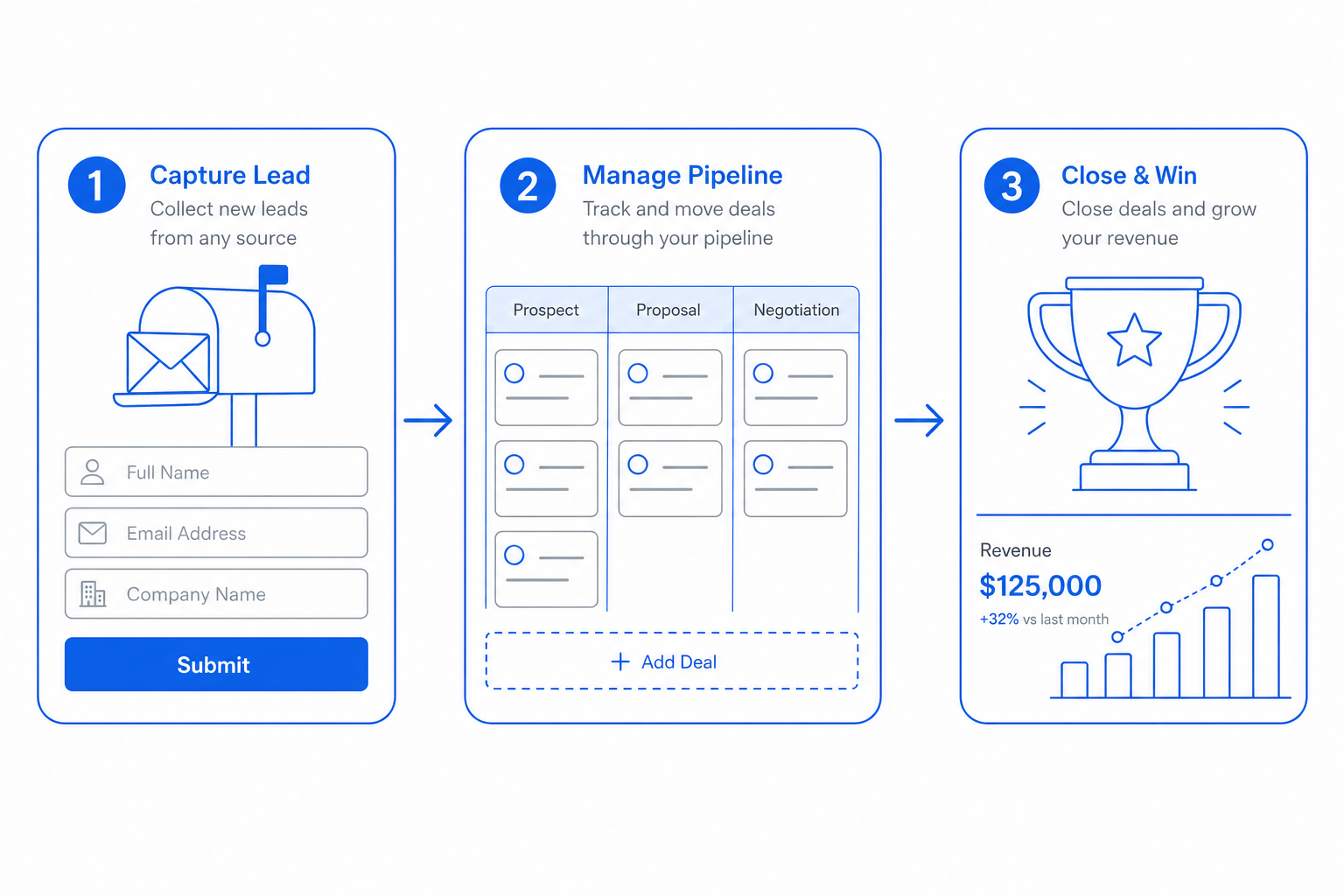
Leads die fastest in spreadsheets. By the time a sales rep notices a row, the prospect has already filled a form on a competitor site. CloudIP lead management captures from web forms and APIs in real time, routes by territory or round-robin, and shows reps the leads they own with the context they need to call.
Convert a lead and the customer record already exists in invoicing — no rekeying.
Inside Lead Management
Specifics that distinguish CloudIP Lead Management from the alternative.
Multi-source capture
Web forms, API, CSV import, and email parsing all land in the same queue.
Auto-assignment
Territory, round-robin, and rule-based routing assign leads in seconds, not hours.
Conversion to customer
A converted lead becomes a customer in invoicing with no manual create step.
De-duplication
Email and phone matching flags duplicates at capture time so reps do not work the same lead twice.
Lead Management on the CloudIP platform
Where this capability lives, who runs it, and what it shares with the rest of the system.
Lead Management runs as part of the CloudIP CRM module on the same multi-tenant infrastructure as every other capability you use. There is no separate console to log into and no separate billing line: lead management software is provisioned the moment your tenant is created and stays in lockstep with the rest of the platform as it grows.
Operators interact with lead management software through the CRM interface they already know — the same record screens, the same audit trail, the same role and permission model. Behind the scenes, multi-source capture handles the heavy lifting, while de-duplication keep the experience consistent across teams. Configuration changes are versioned, exportable, and reviewable, so the way you run lead management software today is reproducible tomorrow.
Because Lead Management reuses the platform's user database, every action is attributable, every record has a stable ID, and every export honours the tenant's data residency choice. That means lead management software reports tie out to the rest of the books, audit logs, and operational dashboards without an integration step in between.
Lead Management fits inside CloudIP CRM alongside the other crm capabilities — they share the same data model, so improvements in one tend to compound across the others. If you are evaluating CloudIP specifically for lead management software, the rest of CRM comes along at no extra cost.
Common questions about Lead Management
Web forms (the website builder, landing pages, third-party forms posting via the inbound API), email parsing, manual entry, and bulk imports from spreadsheets or competitor exports. Each lead carries a source field so you can attribute revenue back to the channel that produced it.
More from CRM
Drag-and-drop kanban with stage rules and automation.
Weighted forecasts, quotas, and forecast-vs-actual rollups.
Drip outreach with steps, delays, and reply detection.
Send quotes that convert into invoices with one click.
Behavioral and firmographic scoring with decay rules.
Geographic and account-based territories with assignment rules.
Try CRM free for 14 days
See Lead Management alongside the rest of the platform on real data.